
What are Card Networks?
double clicking on card tap

We all have a bunch of cards - credit card or debit card, some fancy and colourful and some boring and dull, and regardless of the issuing bank, they must have one of the following symbols above
or or or if you are a “I don’t fit in, I stand out” type, then your card might have “American Express” or “Rupay” or “Discover” on it
So its worth asking the question, what on earth are these symbols doing on the card? and the answer is, these are the card networks that power the transaction that you initiate. In other words, if we were to assume cards are like human cells, then these card networks are the mitochondria of these cells
Let’s dive deeper 🙇
💳 What exactly does a card network do?
There are thousands of transactions happening per second, and in most of these cases, the acquiring bank and the issuing bank is different. So imagine a world where each bank interfaces with the other bank every single time a transaction happens to settle that transaction. Nope, you can’t imagine, because unlike you, this method is superrr inefficient.

So how do we solve it? We need an intermediary. Something that can stand in between, take stock of the situation and reconcile once at the end of the day among all banks involved and not after each transaction.
Woah? Did I say the corporate’s favourite E word : end-of-the-day? Yes I did. Spoiler Alert - Card transactions are not real-time. So, how does that work?
Let’s first look at diagram below by Alex Xu, to understand the bigger picture
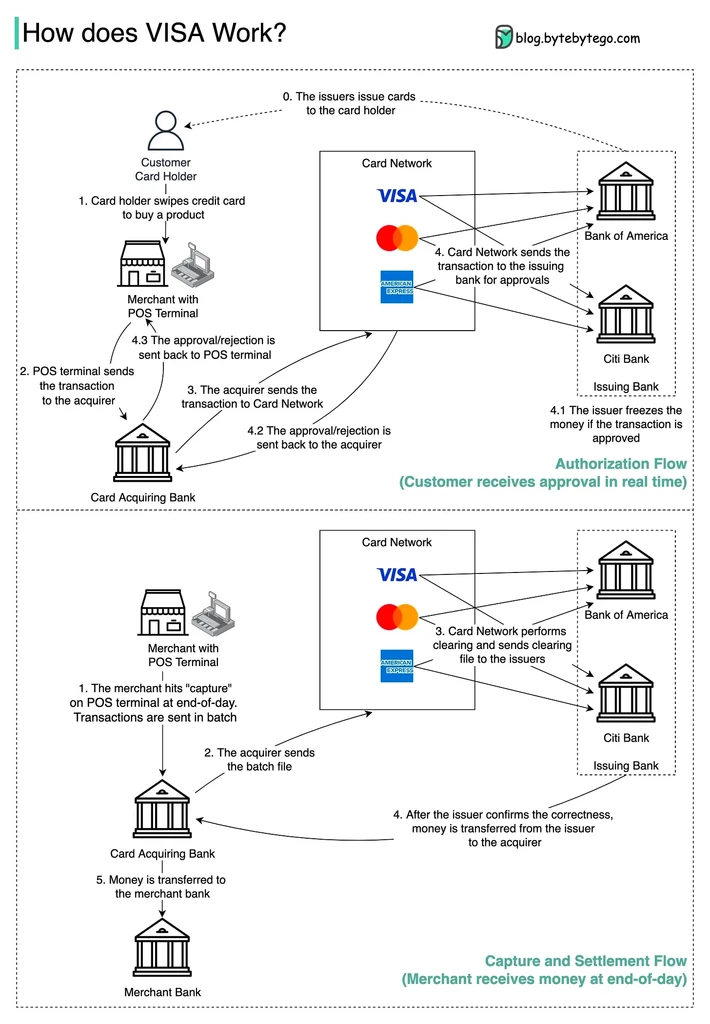
Source - blog.bytebytego.com
Now I understand this looks a bit tricky but just go over it and come back here 📍
Let’s understand using an example.
- You go to a local supermarket store near your place to walk around all the aisles until you finally give in and buy a Haagen-Dazs ice cream. You take that to the counter and tap to pay.
- When you tap, does the money change hands? By that I mean, does the money actually go from your bank to the merchant’s bank? The short answer is No and the long answer is still No. Your money freezes but it is still with your bank. All that happens when you tap is authorisation. So a couple things like if you have enough money in the bank is checked and if all is well and good then a “Transaction Successful” message is shown. This is the authorisation flow. First piece of the puzzle
- Now, this exact same workflow happens with all your friends in all their local stores who might have different issuing and merchant banks
- So here, what a card network provider will keep a track of which bank owes which bank how much. So your bank let’s say Bank A owes Merchant’s bank Bank B
xdollars. Now your friends bank which is Bank B owes another local store’s bank which is Bank Aydollars. - So in this situation, rather than clearing and settling that
xandyamount every single time a transaction happens. It is best to let it accumulate and settle the final amount at the end of the day. This is the capture and settlement flow shown above, the second piece of the puzzle - If Bank A owes $100 to Bank B and Bank B owes $80 to Bank A. So the card network will do the calculation and instruct Bank A to just transfer $20 to Bank B at the end of the day. Much like how Splitwise Simplify Debts work if you know about it, and if you don’t, then you are a lucky one with friends who pay you back on time lol
Now that we have understood the core concepts, let’s look at the periphery
🦄 Types of Card Networks
We have two types of card networks, and they are categorised on the basis of how they function :
Open Network
Card Networks that are open allow other financial institutions to use their network while issuing cards. Famous ones being
- Visa
- Mastercard
Closed Network
One question that might be lingering in your mind is why not individual banks build these networks instead of relying on intermediaries like Visa and Mastercard. That’s exactly what some banks did and we call them closed networks because they just use it for themselves
- American Express
- Discover
🍱 Other Benefits of Card Networks
They are just not efficient, they also bring a host of other benefits to the table such as:
- Infrastructure - Card networks handle the entire pain of developing and maintaining a robust and foolproof payment gateway and processing systems. This also includes encrypting and safeguarding payments data, authorise transactions and transmitting information between relevant parties across millions of locations
- Security and Fraud prevention - Steps to protect customers and merchants from fraudulent activities, unauthorised access and data breaches are undertaken by these card networks. They employ strong machine learning algorithms to flag suspicious transactions even before they happen
- Global Reach - Card networks make the art of payment truly global, you can take your visa or mastercard and pay in tiny cafe in Antartica and still the transaction would go through because card networks will handle authorisation, payment processing and currency conversion. Doesn’t matter what your issuing bank is and what currency you have
🤑 Card fees
Now, all this doesn’t come at no cost, card networks slyly take their cut on each transaction. Yes! There is no such thing as a free lunch.
Every time you tap, 2-5% of the transaction value goes straight to their pocket, which means the merchant only gets the rest. Part of it is passed on to the issuing bank as compensation for issuing and maintaining the payment card.
This is what they call the interchange fees. It is determined on various factors like type of card, payment method, location, merchant’s business etc
This is why, if you have noticed, some merchants prefer cash over card, so that they can retain 100% of the transaction value and not lose that 2-5% to the card networks. But yeah, undeniably, the convenience that card networks brings attracts more customers to the business so its fair and square I guess.

Yippiyayyokaa, now you know how card networks work, but I can’t leave you in good conscience without mentioning the biggest threat looming them. United Payments Interface (UPI), developed by National Payments Corporation of India (NPCI) is a real-time payment method with supports both P2P (Peer-to-Peer) and P2M (Peer-to-Merchant) modes. Currently causing disruptions in India and soon enough in another 10+ Countries. Maybe even both UPI and card networks join hands to bring credit-card to UPI systems
Anyway, it is a story for another day. Cheers 🍻
Stay Curious 🗯️