Analogy Is Infrastructure, Not Ornament
underrated leverage in communication

I started noticing it in the gaps. Confusion would linger, not because the idea was too complex, but because it had nowhere to anchor. Then someone would say, “It’s like this {analogy},” or “Much like {analogy},” and suddenly the brain would set a scaffold into place.
The idea doesn’t change. Its cognitive graph does.
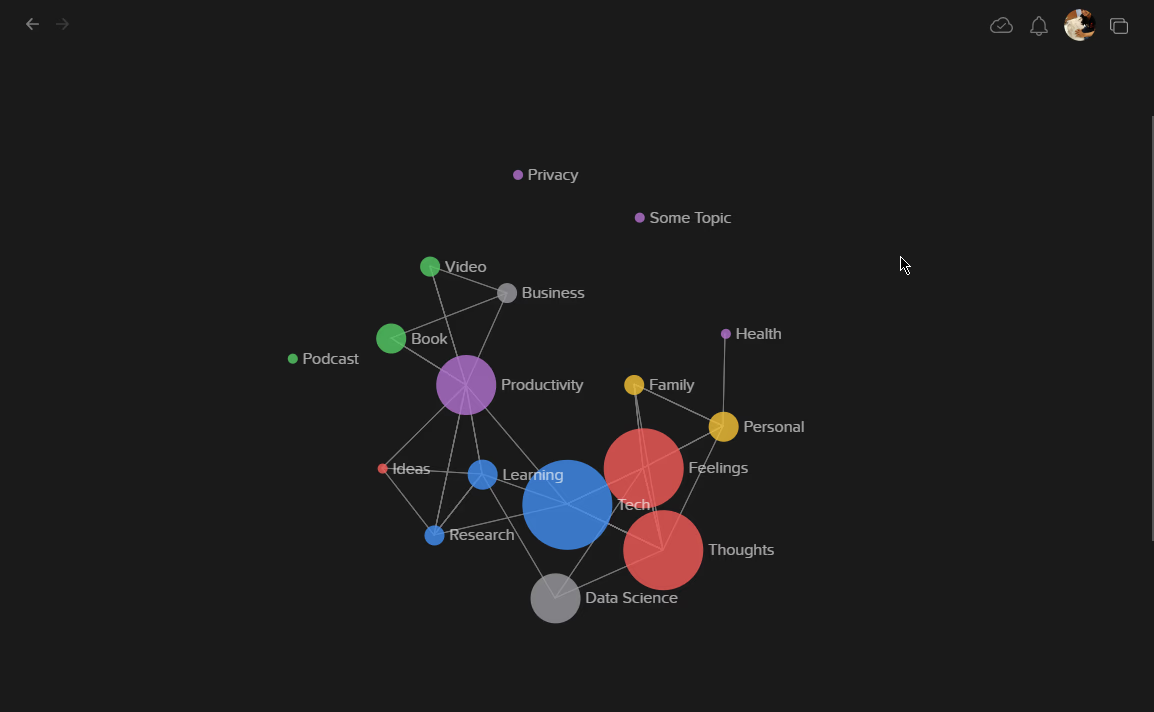
I find it tricky to understand new things by assembling them piece by piece. They become much easier, and more enjoyable, when I can wire them onto a familiar map and connect them to related nodes, much like Obsidian’s graph view [1]. When I explain ideas to others, I reach for the same move almost reflexively. I use analogy to give the thought gravity. That habit pulled this piece together.
Analogy is usually treated like garnish, a rhetorical flourish you sprinkle on an explanation once the real work is done. That view gets it backwards. Analogy is the work. It’s cognitive infrastructure.
Raw explanations fail because they arrive naked. They ask the brain to build new scaffolding from scratch, under time pressure and with limited attention. Analogies cheat. They reuse scaffolding that already exists. When you say “interest rates are gravity” or “memory is a cache,” you’re not dumbing things down. You’re compressing complexity into a shape the mind already knows how to hold. The brain prefers reuse over novelty, and analogy exploits that preference shamelessly.
That’s why analogies accelerate learning and persuasion. They skip the instruction manual and go straight to intuition. A good analogy can collapse a thousand lines of explanation into a single click of recognition. It gives you the dangerous, useful kind of understanding, the kind that lets you predict what happens next. That’s why analogies convince before they convince. You feel the truth before you can defend it.
Bad analogies are landmines. They overfit, mislead, or smuggle in assumptions that quietly rot the conclusion. A bad analogy feels forced, argumentative, sweaty. A good one feels inevitable, like it was always there waiting to be noticed. You don’t nod at a good analogy. You blink. It rearranges the room.
Technical fields pretend to be hostile to metaphor, but they run on it anyway. Math talks about spaces, flows, and curvature. Finance borrows from physics, plumbing, and ecology. Programming is built on factories, stacks, pipes, queues, and garbage collection. Even the most formal systems get explained through analogy, because abstraction without analogy is just static on a page.
Analogy matters most when you use it to think for yourself. When you’re stuck, ask: what is this like? What familiar machine is hiding inside this unfamiliar one? That question turns confusion into a mapping problem instead of a comprehension problem.
Tomorrow, you’ll notice analogies everywhere: in arguments, dashboards, and the ways people explain risk, love, time, and money. Once you see analogy as cognitive infrastructure, you start seeing the structure beneath the explanation.
—
[1]