
Mage-ic with Data Pipelines
all things life is a pipeline
Data pipelines are the backbone of a data project. If you are starting from scratch, that is, not working on a pre-built dataset but starting from building your own dataset, 9 out of 10 times you need a data pipeline to get started with.
What is a Data Pipeline anyway? And why should I care?
Jupyter notebooks, Google Colab, Kaggle notebooks are everyone’s favourite, but if you have to build a data project that runs iteratively and builds continuously, notebooks won’t come through. What you need is robust and reusable collection of code components which together is called a pipeline, that can take in data iteratively and perform the desired functions.
So whatever maybe the data, if you just stick it into the said pipeline, at the end of the tunnel, what you’ll have is ETL-ed data ready to roll in a sweet ML model or Data Viz land
🔮 What is Mage?
Mage is a data integration tool that facilitates the movement of data from various sources to a target destination, and in between, it can perform a whole lot of different operations. It is an open-source tool that provides a simple and efficient way to extract, transform, and load data from multiple sources. But it doesn’t end there, with this simple pipelining concept, you can build you ML model and the pipeline will ensure the ML model keeps retraining based on the new data pipeline provides.
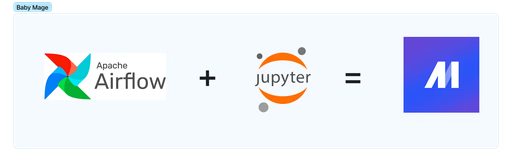
With its intuitive and easy-to-use interface, Mage simplifies the complex task of data processing and provides a range of features to accelerate pipeline development. Best way to look at it is imagining if Airflow and Jupyter notebooks had a baby
🪄 Mage’s Magic Tricks
- Streamlined Data Ingestion: Mage comes out of the box with a wide range of connectors and integrations like GCP, Azure, AWS, Postgres etc that simplify data ingestion from various sources. Whether you’re pulling data from databases, streaming platforms, cloud storage, or APIs, Mage has got you covered. It eliminates the need to write custom ingestion code, allowing you to focus on defining the desired transformations.
- Flexible Data Transformations: Data transformation is at the heart of any data pipeline, and Mage excels in this area. Its expressive programming model allows you to define complex data transformations using a simple and intuitive syntax. Whether you need to filter, aggregate, join, or enrich your data, Mage provides a rich set of operators and functions that make it effortless.
- Scalable and Fault-Tolerant Execution: Mage leverages the power of distributed processing frameworks such as Apache Spark to execute data pipelines at scale. Moreover, Mage ensures fault tolerance by handling failures and retries transparently, minimizing the impact on pipeline execution.
- Extensive Ecosystem: Mage benefits from a vibrant and growing ecosystem of extensions and integrations. You can leverage pre-built Mage plugins for common data operations, such as data validation, cleansing, or machine learning.
- Monitoring and Observability: Understanding the behavior and performance of your data pipeline is crucial for maintaining data integrity and identifying bottlenecks. Mage offers built-in monitoring and observability capabilities, allowing you to track metrics, collect logs, and gain insights into pipeline performance. This visibility helps you identify issues, optimize resource allocation, and ensure the smooth functioning of your data pipeline.
- Developer experience : The ability to write code in Python, SQL, or R within the same data pipeline, as well as useful drag-and-drop component capabilities, component reuse, and the ability to see code output right away in the notebook UI makes Mage a favourite among the developers
💥 How does it stack against Airflow?
- Programming Model: Mage offers an intuitive and expressive programming model, while Airflow uses a DAG-based approach for complex workflows.
- Data Processing Framework: Mage is designed to work with distributed data processing frameworks like Spark or Flink, whereas Airflow can integrate with various execution engines.
- Data Ingestion and Transformation: Mage provides a rich set of connectors and operators for data ingestion and transformation, while Airflow focuses more on orchestration and may require additional custom code or integrations.
- Monitoring and Observability: Mage has built-in monitoring and observability features, while Airflow provides a web-based interface and may require additional configuration for advanced observability.
The choice between Mage and Airflow depends on your specific needs. Mage is suitable for a simpler for a simpler data pipelining needs, while Airflow is well-suited for complex workflows and has a broader range of integrations and community support. But if you are someone just starting out, I’d highly recommend Mage.
🃏 Steps to become a mage-ician
Let’s look at how to install mage and get started with harnessing its powers
-
Install Mage : You can install mage via pip using this simple command
pip install mage-aior you can install via docker, more on that here
-
Initialise a new project :
mage start [project_name] -
Open http://localhost:6789 in your browser and create a new pipeline.
-
Run pipeline using :
mage run [project_name] [pipeline]
If you are stuck anywhere, Mage has an extensive, neat and a helpful documentation which you can find here
They also have an AWESOME slack community with really lovely folks, I have had some serious learnings being a part of the community and so should you.