
Time Value of Money
cha-ching

Imagine I give you two options :
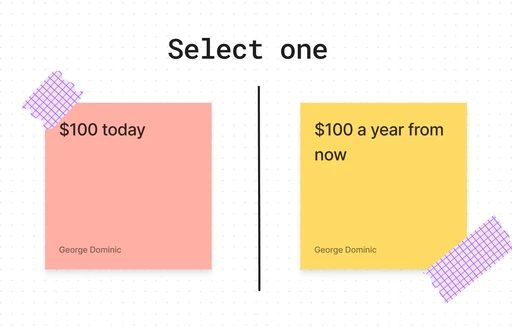
Now you might say - option 1, obviously duhh but what’s the underlying reason behind it? No, I need to pay my rent today, get some beer today, get a haircut today not a year from now is not the main reason. Your $100 has intrinsically more value today than one year from now is the real reason
Time value of money is possibly one of the most important fundamental concepts in finance. Crux of the entire concept is that money today is worth more than the same amount in future. But why is that? There’s several factors that affect the time value of money. Let’s dive into it
Inflation
Over time, the purchasing power of money decreases due to inflation, which means that the same amount of money can buy fewer goods and services in the future. So a $100 that can get you phone pro max ultra today can only get you phone mini a year from now. This is why it’s important to invest in assets that can outpace inflation, such as stocks, real estate, or commodities
Opportunity Cost
If you go for the second option above, you choose to wait to an entire year without a penny. Not only this means you have no money for an year, it also means you lose out on the opportunity to get potential returns on benefits out of that if you have that $100. For example, you could have invested that $100 in stock market and made extra return in one year. In fact, according to historical data, the stock market has provided an average annual return of around 10%
Interest rates
Arguably the most important factor that affects the time value of money. When you invest money, you expect to earn a return on that investment, and the interest rate determines how much you can expect to earn. For example, if you invest $1,000 in a savings account that pays 5% interest per year, you can expect to earn $50 in interest after one year. The higher the interest rate, the more valuable your money becomes over time.
Time Horizon
How long are you expecting to hold an investment. The longer your time horizon, the more valuable your money becomes over time. This is because you have more time to earn returns on your investment, and the effects of compounding interest become more pronounced.
Risk
Risk is the final factor that affects the time value of money. Investments that are perceived as riskier typically offer higher returns to compensate investors for taking on that risk. However, higher-risk investments also have a greater chance of losing value over time, which can reduce the time value of money.
How to use it in your life?
Before we dive into that, some nerdy terminology alert
Present Value : Current value of a future sum of money or cash flow, discounted at a specific rate to reflect the time value of money.
Future Value : Value of an asset or investment at a specified point in the future, assuming a certain rate of return or interest rate over the specified time period to reflect the time value of money.
Discounting : No, this doesn’t refer to your usual upto 15% discounts in stores, it refers to the process of adjusting the value of future cash flows to their present value by applying a discount rate, which is usually the inflation rate or opportunity cost
Now that the terminology is clear, let’s say you are expected to receive $100 in 5 years from now.
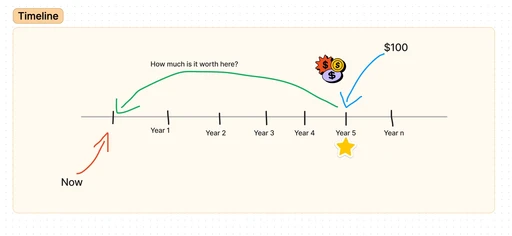
Visualising a timeline is the best way to understand time value of money
To calculate the present value of this future payment. We can use a formula called the present value formula to calculate the present value of the future payment:
PV = FV / (1 + r)^n
Where:
PV = Present Value
FV = Future Value
r = Interest Rate
n = Number of Time Periods
Let’s assume that the interest rate is 5% per year. Using the formula, we can calculate the present value of the future payment as follows:
PV = $100 / (1 + 0.05)^5 PV = $78.35
So the present value of the $100 payment that you are expected to receive in 5 years is $78.35. This means that if you were offered $78.35 today, it would be equivalent in value to receiving $100 in 5 years, assuming an interest rate of 5%. Similarly, you can also calculate future value of $100 that you might have today. This calculation takes into account the fact that money has the potential to earn interest over time, which means that a dollar received in the future is worth less than a dollar received today.
Where is this concept used generally?
The time value of money is a fundamental concept in finance, and it has many practical applications. Some examples of its uses include:
- Determining the present value of future cash flows, such as the expected returns from an investment or the cost of a loan.
- Calculating the future value of an investment, which can help investors understand the potential growth of their portfolios over time.
- Comparing investment opportunities with different time horizons or interest rates, to determine which option is most financially beneficial.
- Evaluating the cost-effectiveness of different payment schedules, such as choosing between a lump-sum payment or a series of smaller payments over time.
- Assessing the impact of inflation on future cash flows, to ensure that investments or loans will maintain their value over time.
Further readings
If you liked this concept, here are some extensions or good to know concepts that you can dive into next :