
Netflixiology : One Last Episode!!
no chill netflix

If you’re reading this, you have probably binge-watched at least once in your lifetime. Okay, let’s not kid each other, it’s more than once. It could be a TV show that your friend recommended or was after your life to watch it or it could be a movie trilogy you’ve been looking forward to watching. So, what exactly is Binge-watching? — According to a Netflix survey dated 2014, binge-watching also known as marathon viewing is defined as watching 2–6 episodes 1 per sitting. Binge-watching is relatively a new behavioral phenomenon that gained popularity after the inception of Over the top (OTT) platforms aka Online streaming services (Netflix, Prime Video, Disney+ Hotstar, Voot, and many more). Relatively new but catching up pretty fast.
A bit of Retrospection, after all never forget your roots 😌
Glancing over the past decade, the television industry has had one of the most seismic and phenomenal shifts both in terms of technology and consumption methods. Nobody anticipated how a burgeoning concept called the Internet would reshape the face or rather the skeleton of the entire Industry. Now, this is a big deal because television is a mass media communication channel, it directly impacts millions of people. One has to no longer wait for days or weeks to watch their 30 min favorite show only to be interrupted by ads right where the suspense kicks in or follow the timetable that the broadcaster tells you to. Emergent online streaming services just take the game up a notch and provide us with something that we all are fond of — “Convenience”. You can now access almost the entire library of your favorite movies/shows from kickoff to climax, day or night from almost anywhere with a decent internet connection. Hell, all you need to worry about is a timely refill of your popcorn bowl. Not to mention a whole bunch of features that the OTT platforms provide like — recommendations based on your interest/previous watch, rewind and fast forward, download and watch later, watchlist option, and our favorite — skip intro option. Terrific, right? along with convenience this also provides an unprecedented level of freedom to watch, pause, continue anytime at your will. Seems like you’re the captain of the ship, eh? Are you? Really?
“The television is ‘real’. It is immediate, it has dimension. It tells you what to think and blasts it in. It must be right. It seems so right. It rushes you on so quickly to its own conclusions your mind hasn’t time to protest, ‘What nonsense!’.” ― Ray Bradbury,Fahrenheit 451
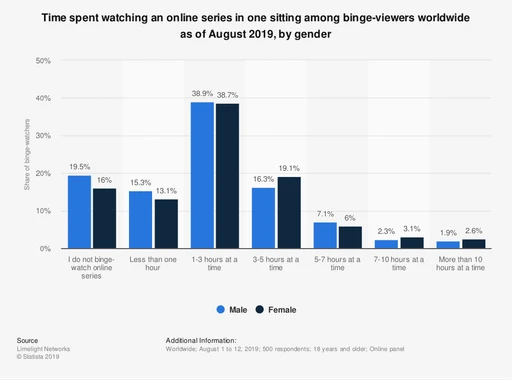
Source :Statista.com
Data speaks louder than words 😃
Don’t believe this is huge? 😕
More than 65% of the total OTT consumers binge-watch for at least 1–3 hours in one sitting and there is ~2% of that population that binge watches for more than 10 hours 2. I wonder when they even sleep. Now, if we look at one of the bigger players in this space — Netflix. Netflix has a subscriber base of around a whopping 195 million paid memberships 3, if the above study is to be believed, around 126 million people are core binge-watchers on average, that is like the entire population of Germany and France combined and this is just Netflix. All this sounds a whole lot serious when you take the age factor into consideration. According to a survey dated 2016, In the US, 90% of the millennials and 88% of the GenZ population in the Netflix community have engaged in marathon viewing 4. Come 2020, along with its peculiarities surrounding the pandemic where the entire world is aiming for Digitisation, offline businesses are going online. Bosses who used to never approve your work from home are somehow more than convinced work can be done from home, even fast-moving grocery items are also just a click away. With all that said, it’s almost a no-brainer to assume streaming services have seen an unprecedented jump in their user base. Netflix added 16 million new users since the start of the pandemic 5. Users are relying more and more on these OTT platforms as they serve as a seamless surrogate for a human connection.
“Why am I letting you comfort me?” He stared over her head. Because I’ve made sure you have no one else to turn to.”
― Kresley Cole,Lothaire
Emotional manipulation disguised as user experience? 😟
Much like Facebook and Instagram who have mastered the art of emotional manipulation, streaming giants are also on the same path with a single goal in mind, nothing but to improve user engagement and retention on the platform. This can’t be achieved if you aren’t acing it in 2 aspects — Technical and Psychological. Streaming giants shell out millions of dollars every year to upgrade and maintain an infrastructure so robust and agile that even in traffic peaks it doesn’t break a sweat, after all, they know what a buzzkill buffering is 6. It is so irksome that according to reports around 40% of the users drop out of the activity after the second buffering attempt.
Paradoxically, the more users they add to their platforms, the more they need to upgrade their infrastructure to ensure uninterrupted delivery.
However, this is not the case with our next aspect in the agenda — Psychology. It’s the more the merrier. Streaming giants like Netflix are rather ridiculously good at this, their Recommendation system — Cinematch for instance uses state-of-the-art machine learning models and AI algorithms that even break users’ preconceived notions and make them watch stuff that they wouldn’t have watched otherwise. According to a study, Netflix’s recommendation system is behind 80% of the stream time 7. Netflix’s VP Todd Yellin told Wired in 2017 “what we see from those profiles is the following kinds of data — what people watch, what they watch after, what they watch before, what they watched a year ago, what they’ve watched recently and what time of day”[7,8]. Amalgamating all these data factors with their algorithms on ranking, search, similarity, ratings, and more, they come up with an experience tailored for every user which is different from the others.
Furthermore, based on this, Netflix is able to group like-minded users into a taste group and target them with a specially curated category like “Award winning police detective tv shows” or “TV shows featuring a strong female lead”. Yes, Netflix has a team of people who dedicatedly categorize everything on Netflix’s diversified catalog into these hyperspecific micro genres to do precision targeting. 8
“When you know what a man wants you know who he is, and how to move him.”
― George R.R. Martin,A Storm of Swords
Design is another major aspect under psychology which influences user decisions. In the top fold alone you can view almost all your most favorite genres (or what Netflix thinks your most favorite genres are, they are almost always correct ). Going from left to right on each row gives you various options in your favorite genre. 8
From Netflix homepage to start a show you just need one click and to watch its trailer you don’t even need that, just hover on the tile and there you go. Minimum user interaction and maximum results lead to an instant commitment by the user. This seamless interface creates a sense of gratification and ease of use among the users that is just hard to resist.
Not to mention a load of features these platforms have apart from their design intricacies, one of the pivotal ones that induce binge-watching more than anything is the autoplay next episode option. When the current episode is close to completion, right when the credits kick in they start loading the next episode giving the user just 5 seconds to decide if they want to drop off or continue and like always we just say to ourselves “Just one more episode”.
So the question has to be asked, how many times were you involved in that decision making — “Just one more episode?”, and how many times were you just led to the next episode in a state of oblivion because you were too moved by the cliffhanger that the last episode just dropped or that seamless switch to the next episode without even a click.
Motivation behind Binge watching 💡
Apart from manipulation techniques deployed by OTT platforms, certain psychological decisions are a manifestation of our own, certainly the techniques act as a catalyst. They do this by exploiting this concept called Theory of Uses and Gratification. According to Wikipedia, “UGT is an approach to understanding why and how people actively seek out specific media to satisfy specific needs.”
Binge watching is a product of multiple forces working together at harmony. One of the main motivations for people to turn to binge watching is because it gives you instant gratification, relaxation and entertainment. Nothing interests them more after a long day of work than getting into their pyjamas and watching their favorite show for hours. This hedonistic activity triggers the release of pleasure hormones like dopamine and oxytocin which gives you a high and encourages your brain to continue the activity, eventually leading to addiction. This addiction is quite similar to the one with drugs and other substances because your brain doesn’t differentiate between different causes of pleasurable experiences. Some individuals see binge watching as an escape from reality, loneliness, a place to avoid their problems and negative thoughts. A coping mechanism to deal with their stress which is great because they are turning away from more dangerous coping mechanisms, so the characters of the show act like their friend in solitude.
Concept of social proof is another motivation to consume online media. TV shows and movies have become an icebreaker in conversations and are a constant topic of discussion in our friend circles. You can tell if someone is like minded or not by knowing the shows they have watched or binge watched per se. Concept of social proof is so strong that I personally have watched a couple of shows just for the memes xD.
Another motivation for binge watching can be attributed to the highly immersive experience the shows provide to a person who’s involved in binge watching. Absolute emotional and cognitive engagement teleports the individual to a fictional world in which they can relate to the character on a metaphysical level. This phenomenon of participation in a one-way relationship with the characters one sees on the show and starts to emotionally connect with them is called Parasocial Identification. This heightens your sense of perceived similarity where you not only identify with the character but also with the events portrayed in the show. All this in turn shoots up your brain’s demand for narration completion.9
This explains why we always sacrifice our sleep for that one more episode because we as humans are desperate for a complete story, a good end that we all deserve. Remember Game of Thrones? It’s funny how everyone criticized the show for the mess they made up in the final season but those same folks anyway watched the entire finale because we just can’t live with partial anecdotes, incomplete plots, and unfinished stories [4].
Risks associated 🚩
There are multiple acute to chronic risks associated with this behavioral phenomenon.
-
Poor sleep quality — Back to back episodes excite your brain and in turn interfere with your ability to sleep peacefully eventually leading to conditions like fatigue and insomnia.
-
Stress and depression — Although Binge watching is usually described as a good stress buster, increased stress and depression levels were reported in a study done on a group of regular binge watchers. This could be due to the fact that they wasted a lot of time binge watching, that they get stressed over finishing the more important tasks that they missed.
-
Isolation — Binge watching impedes your ability to be social and makes it easy for you to disconnect with humans and zone out for hours.
-
Lack of physical activity — Being immobile for a couple of hours not only will give you back problems but also increases the possibility of a heart disease or a stroke.
-
Junk food — Munching while binge watching is kind of inevitable and you don’t need me to tell you the pernicious effects of junk food.
-
Lack of oxygen — Being in a static position for long periods of time decreases your lung capacity by a third.
-
Hormonal imbalance — When you are done with a series, the heightened levels of dopamine go for a toss in an instant and it just can’t be sustained. Brain simulation reaches a low point and it leaves you feeling empty.
Conclusion
I’ll just leave you with this quote :)
“Excessive sorrow laughs. Excessive joy weeps.”
― William Blake